What’s a Stampede Lab?

Elephant Run District has wanted to create an evening of developing works. I wanted to cross-pollinate groups working today and also get people from Off Off Broadway’s past in the same room. After the Living Theatre recently won the fight to keep in its space, we thought TLT would be the perfect location for this event. Often, we work alone and only know if what we’re doing is on the right track after the first weekend of a fully-mounted production. Or, there’s an endless amount of readings of plays.

We hope Stampede Lab will be a different path and pull people in our far-flung territory together. Each presentation is 15 minutes, followed by a quick Q&A/Trivia Contest hosted by me. Then we’re going to do something to honor the spirit of the Living Theatre.

Our first lab will include a tribute to Steve Ben Israel, a former member of the Living Theatre.

We’re going to do an overlapping reading of 3 of his poems, with a video of one of his signature pieces performed by Steve Ben.

Admission to Stampede Lab is free. Donations will be accepted at the end of the night for the Steve Ben Israel memorial. If you can’t attend, please give at www.indiegogo.com/stevebenisrael.

On Tuesday, June 19, 8 to 10 p.m.

Elephant Run District presents

Stampede Lab

a curated evening of indie theater works,
at The Living Theatre, 21 Clinton Street.
Where artists from Off Off’s heritage mix
with the people making it happen today.

3 downtown theater companies will each present up to 15 minutes of soon-to-be produced pieces. Smart, daring, funny, challenging, raw and focused. In between there will be short interviews, conversations and trivia. No lame talk-backs, no excruciating soap boxes and no rambling work.

Featured artists on June 19 will include: Ashlin Halfnight, Homunculus Mask Theater Company and Original Binding.

Keep Momma Malina in her Home

Aimee and I saw a couple Living Theatre-related events this week. First we went to an evening celebrating the release of Judith Malina’s book The Piscator Notebook. It is always amazing to hear her talk. This event had a little something extra because it took place in the same room where she learned from Erwin Piscator.

We went last night to see the new print of The Connection at the IFC Center. It was astounding to see this. I’d never seen it previously and found myself time and again imagining the ripples this play must have made when it was first performed.

The Living Theatre has made contributions to the theatre that continue to impact the work done today. And, in fact, the Living Theatre and Judith Malina, now aged 85, continue to create theatre. As Brad Burgess, the Living Theatre’s executive producer, has said, she is the mother of Off Broadway.

For those who don’t know about the struggle the Living Theatre has had please read this article from the Village Voice. She is a member of the Theatre Hall of Fame. In some ways, she has outlived her legend but continues to do her work. Members of the theater community should support her. One day, one of us might be so lucky to live so long and to keep pursuing our passions.

They only have one more day in their fund drive. Please give generously at the link below and spread the word.

http://www.luckyant.com/livingtheatre

The 4 Actual Types of New York City Theater

I have been thinking about these categories for many months now. I believe they cover all the variations one can find in New York City today. It is time to end the old way of things. Broadway, off-Broadway, and off-off Broadway designations do not do justice to what is really happening. To many, these classifications represent quality. In reality, they do not. Also, they do not represent where they are geographically. If this were true, the United Palace in Washington Heights would be a Broadway theater. Technically, they signify the number of seats in a theater. off-off is 99 seats and below. Off-Broadway is 100 to 499. Broadway is 500 seats and above.

I call for these 4 types of theater to be used when defining the type of theater you are seeing.

1. Destination Theater. Originally, I wanted to name this Tourist Trap Theater. I decided that was too harsh. If this name is to stick it should have something positive about it. (Of course, one could argue “off-off” has a negative connotation but that moniker has stuck for more than five decades so what do I know.) Destination Theater is made with big budgets and has some element most people know already. It has a name involved many people coming to the city would already know or the material is familiar. On the positive side, it brings needed money to the city.

2. Hometown Theater. There is a certain civic pride to theater made in NYC. It is for New Yorkers by New Yorkers. The local heroes involved in these projects carry a stamp of approval. People seek out this type of theater because their friends and other people they know whose opinions they respect will go to see it. (Note: New Yorker as defined here is anyone who has lived here long enough to self-identify as a New Yorker.)

3. Artisanal Theater. Usually vetted outside the city and imported in, this type of theater is pricey. People go to see this because certain publications have given their approval of it. Standing in the lobby at intermission, you can frequently hear patrons say they have no idea what is going on. I don’t know if this is because the patrons usually spend their time thinking about other things or because they have so much money they do not care whether they understand something or not. They know so-and-so from such-and-such said it was good so it must be good.

4. Indie Theater. Made by the artists. Usually for budgets less (often way less) than $30,000. They mostly have runs of under three weeks because of rules in place by Actors’ Equity and because tickets sales will never pay for the production, even if each night is sold out. It is the bedrock of New York City theater. People go to see this because they know one of the artists involved, want to work with one of the artists involved, or have slept with or would like to sleep with one of the artists involved. Or they would like to see one of the artists involved fail. The audiences usually are either overly-friendly or very guarded.

5. Added category. (I don’t know if this should actually count. Therefore, it’s not lumped in with the big four.) Bad theater. There is a lot of bad theater in New York City. There is more theater in New York City and more than its fair share of bad theater.

I believe this covers it. There are variations. Sometimes a piece of theater might go under more than one category and, yes, there could be sub-categories. But I think the main factors for categorization are money and approval. The amount of money spent on a production and who approves the work really determine the actual type of theater that is being made.

Pictured above, a Destination Theater on 41st Street in New York City getting prepared for a musical, produced by Disney and based on a movie, to begin its run.

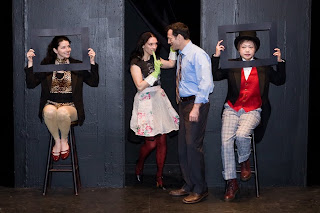
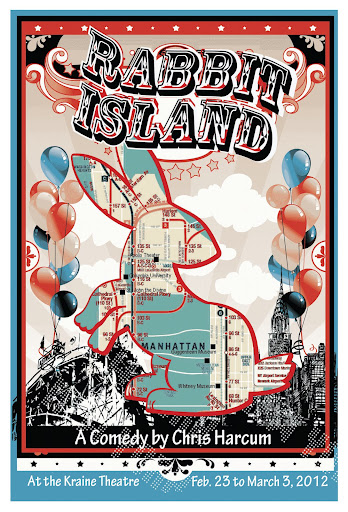
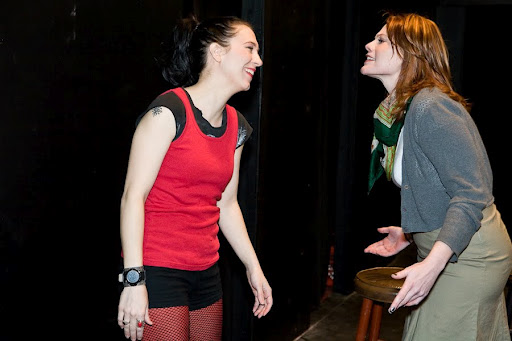
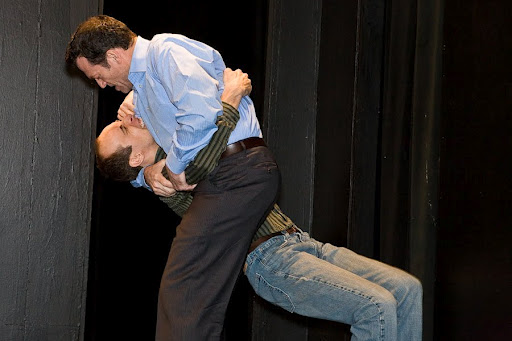
Go To Rabbit Island

Rabbit Island, is in the Frigid Festival on Thurs, Feb. 23 at 9 p.m., Sat, Feb. 25 at 8:30 p.m., Mon, Feb. 27 at 7:30 p.m., Thurs, March 1 at 6 p.m., and Sat, March 3 at 5:30 p.m. Tickets are $12 to $16. Click here for tickets. (Search “Rabbit Island”)

At the Kraine Theater, 85 East 4th Street. East Village, NYC.

Subway: F to Lower East Side–Second Ave, 6 to Bleecker Street

Running time: 60 minutes

Rabbit Island is named a MUST SEE by The Local: East Village Blog for The New York Times.

The playwright Chris Harcum is interviewed on The Happiest Medium.

Visible Soul interviews members of the Rabbit Island Creative Team:

Ethan Angelica


Laura Butler

Chris Harcum

Carrie Heitman

Mel House

Mariko Iwasa

Joel Nagle

Aimee Todoroff